
Guess What’s Next, Make Some Cash: A Guide to the Best Prediction Websites
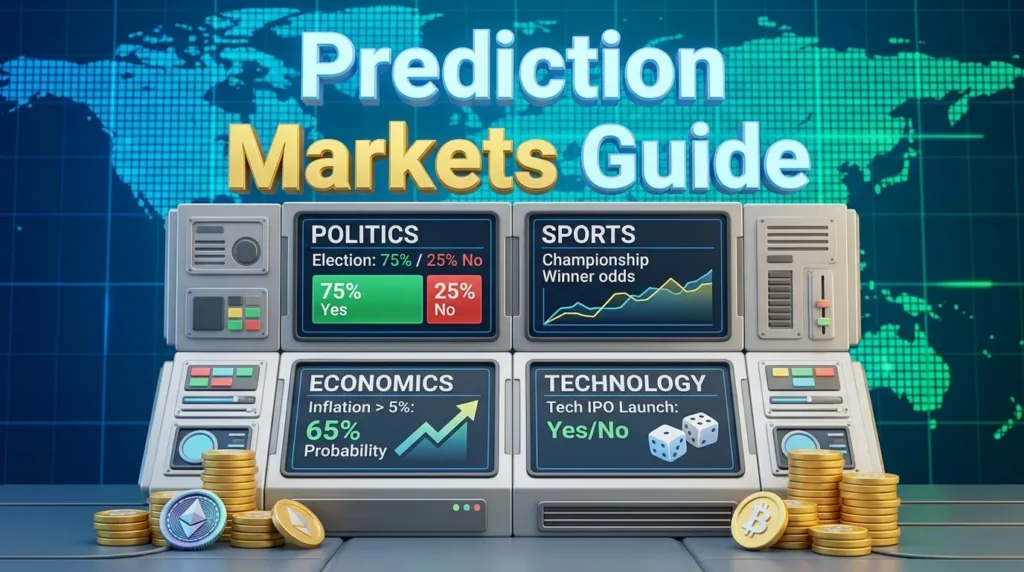
Prediction markets let you profit from your insights about upcoming events. You can bet on just about anything. This covers the results of political contests, sports finals, economic updates, and also trends in pop culture. This guide explains how these markets work and points out just how popular they are. We’re going to check out the best sites for predictions in various categories. We’ll dive into the key upsides and downsides as well.
In the end, you’ll notice how these sites stand apart from a typical online sportsbook.
1.

Welcome Bonus:
500% + 500 FS
2.

Welcome Bonus:
$100,000 Weekly Raffle
3.

Welcome Bonus:
325% up to $10,000 + 200 FS
4.

Welcome Bonus:
Up to $20,000
5.

Welcome Bonus:
$75,000 Weekly Raffle
6.

Welcome Bonus:
–
7.

Welcome Bonus:
$100 when you use Bet Stack
8.

Welcome Bonus:
–
9.

Welcome Bonus:
Up to 500%
10.

Welcome Bonus:
–
So, What Is a Prediction Market?
A prediction market lets you wager on what might happen in the future. Think of it this way: you buy or sell shares that reflect a particular outcome of a real-life event.
How the Contracts Work
Every contract revolves around a question that you can simply answer with yes or no. For example, could inflation go over 2%? Will a specific team come out on top? Will a cryptocurrency hit a specific value in 2026? If the result is yes, the contract is valued at $1. If the result is no, it holds a value of $0. Each contract comes with a purchase price that ranges from $0 to $1. This price shows what the market thinks about the likelihood of the event happening. For instance, a contract priced at $0.65 indicates that the market believes there’s a 65% likelihood of a “yes” outcome. If you agree with that perspective, you can grab it for $0.65. The end result is always either $0 or $1, so you can quickly figure out your possible profit or loss. Prediction sites roll out hundreds of fresh contracts every week in fields like politics, sports, crypto, health, and a bunch of other areas.
Sportsbooks and Prediction Markets: A Clear Contrast
In a traditional sportsbook, you place bets against the house. If your guess is off, the operator takes your money. Prediction markets operate quite differently. Think of it as something similar to a stock market. You swap contracts about upcoming events directly with other users instead of dealing with the site. The app is simply a platform that links up buyers and sellers. It then takes a tiny cut from the earnings.
That’s why you want a prediction site that’s got plenty of active traders.
Core Actions in Prediction Markets
When it comes to markets predicting events, there are some basic steps to take. You can guess if something’s going to happen, place a bet against it, or even pull out early. Here are the three main things to do.
- Back an Outcome: If you think something will happen, you buy a “Yes” share. Imagine a team’s “Yes” share price sits at $0.50 to win; you’d grab that share for fifty cents;
- Oppose an Outcome: If you think an event won’t occur, you buy a “No” share. If a team isn’t likely to win, a “No” share might be priced around $0.60, and you can buy it to bet against their victory;
- Protect Your Profits: You can sell a share before the event wraps up to secure a profit. If you purchased a “Yes” share for $0.30 and the price rises to $0.70, selling it means you get a $0.40 return without having to check the final outcome.
How Prediction Markets Work: A Case in Point
Let’s take a look at how these markets function through a particular example. Picture the Grand Finals at the Starfire Arena in 2026. You think you’ve figured out who will win and want to take action based on that prediction.
- Find the market for the championship game. For instance, “Yes” shares for the Solaris Titans are priced at 80 cents, whereas “Yes” shares for the underdog Void Strikers are just 20 cents. Select the “Yes” choice for the Void Strikers.
- Think about how much you’re willing to invest. To spend $100 on this outcome, place an order to buy 500 shares at the current price of 20 cents each.
- Make sure to review the transaction summary. It’ll display a total cost of $100 along with a possible payout of $500 if your guess is right. Each valid share earns you a dollar.
- Finish your trade with one last click. Your shares have been bought, and your position is up and running in the market.
- Now, you can hang onto the shares until the event wraps up to find out if you’ll get the complete payout. Or, you can unload your shares anytime before the match wraps up.
Prediction Markets in Action
Let’s move past sports and turn our attention to politics. A market might wonder, ‘Is the Federal Data Privacy Act going to pass in the Senate by June 2026?’. Shares for ‘Yes’ could go for around 40 cents, whereas those for ‘No’ are priced at 60 cents. If you’re sure about it and place $100 on ‘Yes’, you can grab 250 shares. A correct outcome indicates that every share pays out $1, bringing the total to $250. In the case of crypto, you might see a prompt wondering if Ethereum’s upcoming major upgrade will roll out before Q4. If you’re uncertain about the timing, you can purchase ‘No’ shares.
Prediction Prices: A Comparison
The odds from sportsbooks and the prices found in prediction markets really share the same idea: they both express a possible payout and the likelihood of a certain result. They simply use various formats to display it. Here’s a side-by-side look.
| Item | Sportsbook Example | Prediction Market Example |
|---|---|---|
| Initial Cost | A $100 bet on a specific team | Starting with $100 to buy shares |
| Presentation | Odds are presented as +400, showing profit potential | A “Yes” share price appears as 20¢ |
| Total Return | Winning gives you a total return of $500 | A correct prediction earns a total return of $500 |
| What it means | Odds indicate a 20% chance of success | The price suggests a 20% chance of success |
Prediction Markets
Sportsbooks factor their profit into the odds through something known as the “vigorish,” or vig. For a regular bet, you need to stake $110 to win $100. This smart arrangement provides the house with an automatic advantage of nearly 5%. Prediction markets operate in their own unique space. Here, all you need to do is do better than what other traders think. These platforms operate similarly to a stock market, making money through small trading fees rather than from users’ losses. The commission is quite small, ranging from 0.5% to 2%. That’s a clear difference from the usual 5% cut taken by sportsbooks.
The Prediction Market Ecosystem

The prediction market field has a variety of offerings. Each one has its own way of running things and specific expertise.
A Look at Various Prediction Market Models
Prediction markets aren’t identical in design. They operate using various rules and kinds of money. Their main setup usually hinges on who’s in control and which currency they take.
- Real vs. Play Money: In some markets, you deal with real cash, meaning when you get your predictions right, you actually make money. Others focus on training or competition; they rely on virtual tokens that carry no actual monetary worth at stake;
- Centralized vs. Decentralized: Instead of one company running a market by itself, multiple parties share the responsibility. It lays down the rules and makes sure the money is in place. Decentralized versions rely on blockchain technology, letting smart contracts take care of results on their own—no middleman needed;
- Crypto vs. Fiat: You’ll come across systems that operate exclusively with digital currencies such as ETH or BTC for everything transactions-related. On the other hand, some places rely on conventional currencies like AUD or EUR and follow strict financial regulations.
A Look at Major Prediction Markets
This table gives you a glimpse of important prediction markets you’ll find in 2026. We picked these names based on what they focus on, how they operate, and their standing with regulations, so you have a solid understanding.
| Site | Operational Model | Core Focus and Compliance |
|---|---|---|
| Kalshi | Federally Regulated | Offers CFTC-approved event contracts on economic, tech, and cultural happenings |
| Polymarket | Blockchain-Based | Runs on a public blockchain for global event outcomes outside US financial oversight |
| DraftKings Predictions | Major Betting Operator | An integrated feature for its sports book with prediction pools in several US states |
| FanDuel Predicts | Major Betting Operator | Focuses on sports outcomes in select areas and has some commodity futures |
| Fanatics Markets | Major Betting Operator | Grew through acquisitions and now uses crypto exchanges for some settlements |
| Robinhood | Financial Broker | Introduced prediction contracts for political and sports events to its main trading app |
| Crypto com | Crypto Exchange | Houses prediction markets on politics and finance alongside its digital currency exchange |
| PredictIt | Niche Political Focus | A specific market for US political outcomes—no sports or other types of events |
Where Prediction Markets See the Most Action
You can discover markets around shifts in government or the likelihood of rain. Most activities group into five basic market types.
The Pulse of Politics
Political markets track key happenings. You can bet on who will win the presidency or pick up “yes” shares for a certain new law. Other agreements center around judicial positions or how a party manages the Senate. These markets definitely have an advantage compared to traditional polling methods. When real money is at stake, folks tend to make smarter decisions. A debate wraps up, and suddenly a scandal pops up—the market price changes right away.
This gives you a real-time view of what people think.
Trading Sports Outcomes: A Different Model
Prediction exchanges aren’t the same as sportsbooks. You swap results directly with other folks here. You can have a say on much more than just the outcomes of games. Consider whether a manager might be let go or if a player reaches a notable milestone in their stats. It operates using either “Yes” or “No” shares for an event. A right share ends up being valued at $1, while a wrong one lands at $0. These are financial items regulated by financial authorities.
Future of the Economy and Companies
These markets look at how the economy is doing and how businesses are performing. You can foresee things like official inflation numbers or shifts in central bank rates. Will a major stock index reach a certain level? Predict a big car manufacturer’s unit sales for the quarter. People turn to these markets to protect themselves from financial risks or to respond to predictions about significant economic shifts, all without needing overly complex financial tools.
Crypto Prediction Topics and Uses
A lot of prediction markets look ahead at token prices. Their attractiveness, though, stems from choices linked to big happenings such as an ETF approval or a noteworthy network upgrade. That’s part of what makes them so well-liked. A crypto holder can tap into them to safeguard their assets from unexpected market fluctuations.
They also serve as solid hints for what might come next.
How Elite Groups Predict Global Events
These groups unite skilled forecasters, people who have consistently demonstrated impressive accuracy in their predictions. They provide accurate predictions on things like election results, how well a new smartphone will sell, or upcoming scientific breakthroughs. Every forecast comes with a particular chance. When you put these group predictions together, they give a solid idea of what could occur.
Companies tap into this information to make market choices, while governments use it to create new policies.
Prediction Markets vs. Sportsbooks: Which One Suits You Better?

Prediction markets and traditional sportsbooks have distinct setups. These key differences have a direct influence on your ability to predict and the returns you can expect.
Prediction Markets vs. Sportsbooks: The Main Differences
Think about where you’d like to place your bets.
This comparison highlights the key differences between modern prediction markets and traditional sportsbooks, helping you choose what works best for your approach.
| Feature | Prediction Markets | Licensed Sportsbooks |
|---|---|---|
| Regulation | Regulated nationally by financial watchdogs | Supervised by state or provincial gaming control boards |
| Availability | Available nearly everywhere, but some local jurisdictions can create challenges | Operations are limited to states or provinces that allow it |
| Consistency | The same options show up on all platforms that use the market | Betting options can vary significantly between regions |
| Concept | You trade contracts that settle at either $0 or $1 | You bet on odds set by the house, winning or losing in the end |
| Format | You compete against others in a peer-to-peer environment | Your main competitor is always the house, which is the sportsbook itself |
| Fees | You pay a small fee, typically between 0.5% and 2%, on trades | The bookie’s margin is buried in the odds—commonly about 5% or more |
| Price Transparency | Prices are determined by the crowd and reflect direct probability | Odds include a profit margin that hides true probabilities |
| Exit Early | You can sell your stake at any time to secure a profit or limit a loss | A cash-out option might be available but often comes with poor terms |
| Liquidity | Can be thin for niche events; the availability of funds relies on other users | You’ll find reliable liquidity because the house will always take the opposite side of your bet |
| Limits on Bets | Bet sizes are typically small unless the event draws massive attention | Higher limits are standard, especially for popular sports leagues |
| Events | Includes sports, politics, finance, and pop culture themes | Primarily focused on sports, with a few novelty bets |
| Live Action | In-play options are quite rare or completely unavailable | A wide array of live, in-game selections is typical |
| Parlays and Props | Multi-leg bets aren’t allowed, and prop bets are rare | Parlays are easy to create, and you’ll find plenty of prop bets |
| Accessibility | Best suited for those familiar with financial markets | Straightforward to navigate, ideal for newcomers |
| Best For | People who are analytical, traders, and those looking to hedge | Great for casual entertainment and fans who enjoy accumulators and live action |
Weighing the Pros and Cons
When it comes to prediction markets, you’ll find some clear advantages along with a few downsides to think about. People need to grasp these things before putting any money on the line.
The Core Strengths
Check out the key advantages this system provides. These markets offer distinct advantages for users, like improved predictions and more control over your positions.
Check out what sets it apart from other models.
- When financial stakes are high, it sharpens attention, leading to precise forecasts since people tend to scrutinize info more closely;
- Prices for outcomes refresh instantly—a straightforward result of supply and demand dynamics in the market;
- Group insight comes into play, where accurate predictions are prized much more than just popular views;
- The odds for any result are completely clear, as the price itself reflects the probability as a direct percentage;
- You can manage risk with total freedom since selling a position before an event wraps up is always an option;
- The house cut is considerably lower compared to the hefty fees you usually encounter with conventional sportsbooks;
- There’s a wide range of markets available, extending well beyond sports to incorporate elections, economic indicators, and corporate earnings.
Potential Downsides and Limitations
To get a complete understanding, it’s crucial to recognize the obstacles that come with this activity. These points pinpoint spots where you could encounter some limitations or hit a few bumps in the road.
- Regulatory Inconsistencies: The rules can vary quite a bit depending on the region. Some local authorities in 2026 are blocking certain types of contracts, making things a bit trickier for those involved;
- Market Liquidity: In smaller markets, you’ll find there aren’t as many buyers and sellers around. This small book can delay the steps needed to fulfill big orders or settle a position at a target price;
- Moral Questions: A few contracts relate to delicate global situations. This brings up moral concerns regarding profiting from tough circumstances, something that many people feel uneasy about;
- Price Manipulation Risk: Markets that don’t see much action can easily be taken advantage of. A trader who has a lot of money can sway prices, making it tough for those with smaller budgets;
- Limited Sports Options: The choice of sports events is narrower than what you’d find in a usual sportsbook. You’ll notice the big leagues, but you often won’t find choices for unique prop bets or multi-leg parlays.
Who’s in Charge of the Rules?
Prediction markets function based on a blend of guidelines. Both national finance organizations and local gaming commissions have a voice.
A Clear Explanation
People don’t see these markets as a form of gambling. Instead, they act more like money tools, regulated by the financial rules of the country. A national group keeps an eye on this activity. Initially, these markets focused solely on commodity prices or stocks from various companies. Today, they can legally include results for sports or elections since they have clear approval from the regulators.
Government Rules and Special Permissions
Officials consider prediction markets to be financial tools, which means the same agencies that oversee futures contracts are in charge of them. This happens because people are swapping with one another, not a house. Financial regulations usually need a contract to counter a real economic risk or to find a price. When a contract doesn’t meet these standards, the operator can request special permission. Regulators approve this when the contract shows it’s beneficial for the public, has clear results, can’t be altered, and keeps the market stable.
Disputes Over Local Laws
Prediction markets suggest that federal financial rules provide them with approval. Many state governments, on the other hand, have a different perspective. Some local authorities, especially in states with tough gaming laws, put out orders to halt operations. They consider some contracts to be illegal wagers. These disputes over legal power are currently wound up in the courts.
The Horizon for Prediction Markets
Prediction markets have really taken off lately, and the amount of money flowing in has significantly increased. Analysts predict ongoing growth, but challenging regulatory issues are likely to shape the sector’s direction. Funds will probably gather at a handful of major commercial operations, a trend that reflects the growth of online sportsbooks.
Important Indicators for Prediction Market Traders
If you want to get a leg up in prediction markets, it’s vital to pay attention to certain signals that indicate upcoming changes. Pay careful attention to these important points so you can safeguard your money and discover fresh opportunities.
- Stay updated on new laws and court decisions. These announcements indicate the places where you’re allowed to trade.
- Check out how the exchanges you use navigate regional legal hurdles. Their approaches suggest a steady future.
- Keep an eye out for fresh market categories, such as proposition contracts. They provide various methods to discover profit.
- Look into liquidity levels for particular events. High volume lets you jump in and out of your positions swiftly.
- Keep an eye on when mainstream media references market prices. This fresh spotlight can trigger quick shifts in the market.
- Prepare for significant election periods. These political happenings consistently draw significant attention and stir up fluctuations.
- Keep up with the latest in crypto regulations. They have a direct impact on the way decentralized hubs function and how you can access them.
Your Questions on Prediction Markets
Got questions about how prediction markets work? We’ve got the answers to the usual questions right here.
Take this info to grasp the main concepts and shape your choices.
Are Prediction Markets Like Gambling?
Legally speaking, they aren’t. Financial regulatory authorities keep an eye on prediction markets, rather than gambling commissions. The activity includes buying or selling contracts for upcoming events, which is different from placing a bet against a house. That said, there are some practical similarities. You put money on the line hoping to make a profit from betting on unpredictable outcomes.
Can I Legally Use Prediction Markets Where I Live?
The legality of prediction markets really hinges on where you are located. Many countries treat these markets as financial derivatives, distinguishing them from sports betting. This lets them function according to finance regulations.
Check with your local financial authority to see the status in your area.
Where Can You Find Better Payouts: Prediction Markets or Sportsbooks?
Prediction platforms often provide more enticing returns. Their charges are pretty low, usually ranging from 0.5% to 2% per trade. A sportsbook, on the other hand, usually includes a house edge of about 5% for standard bets. This shows that prediction markets can offer you greater value. Still, sportsbooks could offer better chances for profit on some lines.
It’s a good idea to check prices first before moving ahead.
What Are the Real Dangers in Crypto Forecast Markets?
Crypto forecast markets come with serious risks. The cost of many digital assets can shift wildly without any warning. Some people think these areas provide pros with superior data, giving them an edge over regular participants. A wise step is to invest only what you can afford to lose and decide on clear points for getting out.
What really sets a prediction market apart from sports betting?
Actually, they are quite different systems. Prediction markets operate a bit like a stock exchange but for the outcomes of various events. You buy and sell shares whose worth shifts according to how likely an event is to happen. You can deal with other users. Sportsbooks, on the other hand, require you to put a set-odds wager straight against the house.
How Should a New User Safely Begin?
To kick things off safely, choose a prediction site that’s under consumer protection laws. Start off with a small initial deposit, like €20. Then, go ahead and make a few easy trades. This gives you a better understanding of how outcomes affect prices and ways to handle your positions. Once you’re confident in how the site’s system works, you can start checking out other types of contracts.